



In many industries, raw materials go through various stages of processing, such as conveying, crushing, screening, and sorting, before they are processed for the final stage of production. During transportation, small metal fragments may be mixed with the raw material. The fragments may come from worn-out parts of machines, rivets, or scrap metal, among other things. They may cause production issues if not removed at the initial stages.
To avoid these issues, various industries have relied on magnetic separation methods. One of these solutions involves the use of magnetic drum separators. This equipment helps in the removal of ferrous particles from various materials like minerals, coal, aggregate, and recyclables. The equipment has a magnetic drum as well as a magnetic field, which can assist in the separation of the magnetic particles, and the other materials move on in the processing line.
Understanding the Role of Magnetic Separation in Material Processing
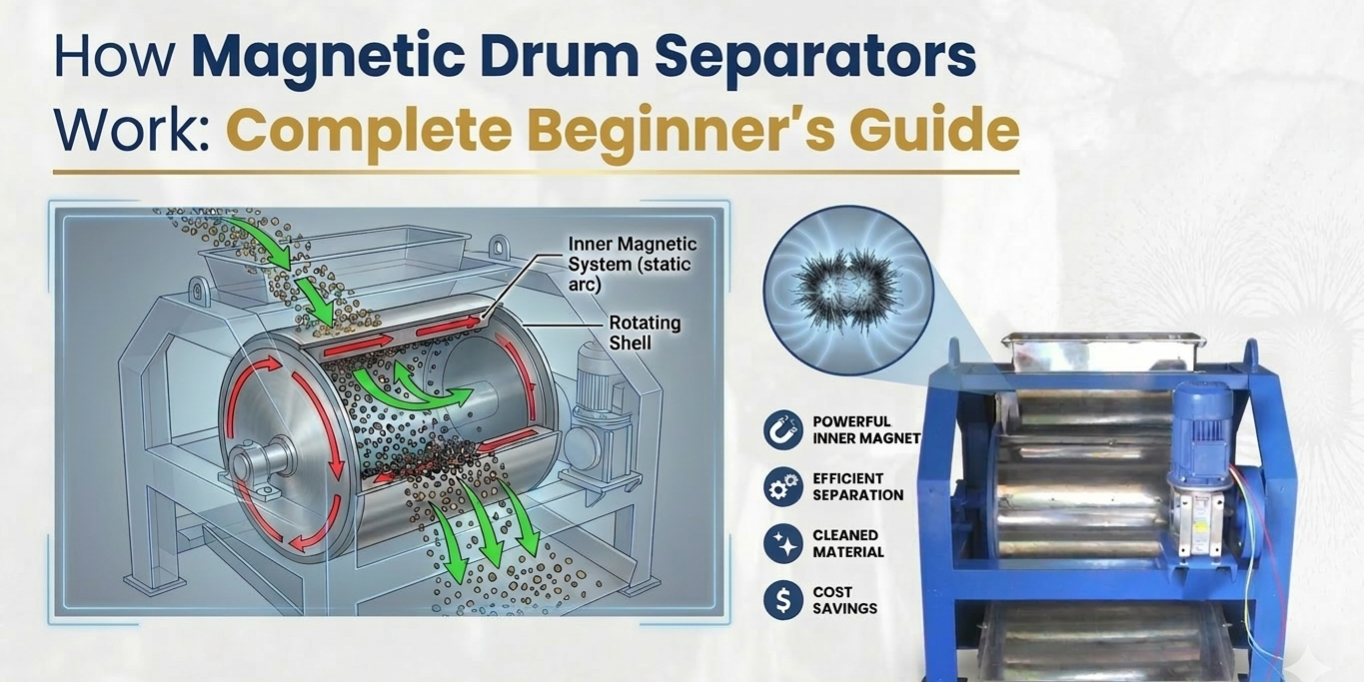
The question that has been asked by many is how does magnetic drum separator work in real-life operations. The answer to this question is rather simple. The magnetic separator has a rotating drum with a stationary magnetic system inside it. As mixed materials move over the magnetic drum’s surface, magnetic materials are attracted to the drum while non-magnetic materials move forward. The process involves the following steps:
-
Bulk material flows onto the rotating drum surface
-
Magnetic particles are attracted to the drum shell by the magnetic field
-
Non-magnetic materials continue along the normal processing path
-
The drum rotation carries the captured metal particles away from the feed area
-
Once the particles move past the magnet section, they fall out onto a separate discharge port
Since this process is continuous, there is no interruption in the removal of metal contaminants in the industry.
Core Components Inside the Rotating Drum
A magnetic drum separator has some major components that enable it to work effectively in different environments. The outer drum shell is the rotating cylindrical part that is in contact with the material to be separated. Inside the drum, a magnetic assembly is fixed in position. The fixed position of the magnet ensures that the magnetic field remains constant as the drum rotates to move the separated metals to the discharge point.
The magnets within the drum are structured in such a manner that they form a curved shape. This design ensures that there is a strong magnetic area where the material makes contact with the drum’s surface. As the drum rotates, the magnetic particles remain attached to the surface until they move away from the magnetic field area. The other significant components of the system include:
-
Feed chute that guides the material onto the drum
-
The drive mechanism that controls the drum rotation
-
Separate outlets for magnetic and non-magnetic materials
-
Support structure that holds the entire unit in place
All of these components combine to ensure the smooth running of the system during continuous handling of the material.
Magnetic Field Behavior and Separation Mechanism
To understand the magnetic drum separator working principle, it is helpful to understand how magnetic forces behave around ferrous materials.
The magnetic system has a powerful magnetic field that passes through the drum shell. When material passes over the surface of the drum, ferrous material reacts to the magnetic field and sticks to the drum. Non-magnetic materials such as sand, minerals, plastic, or metals do not react to the magnetic forces. These materials pass forward as normal.
As the drum rotates, it also causes the movement of the magnetic particles along the surface. However, when the particles reach the point where the magnetic field is not available, the force of gravity causes them to move away from the drum, thus falling into a different collection point. The basic working principle of the drum enables the industry to separate the unwanted metallic particles from the materials in an efficient manner.
Operational Advantages in Continuous Material Handling
A drum type magnetic separator is widely used in various industries since it operates efficiently and effectively in separating magnetic particles from the materials. Some of its advantages:
-
Continuous separation without interrupting production
-
Effective removal of ferrous contaminants from bulk material
-
Protection for crushers, conveyors, and other downstream equipment
-
Low maintenance because of a simple and robust design
-
Improved product purity and smoother production flow
Because of the above advantages associated with the use of drum separators, they can be used in different fields such as mining, recycling, cement, and aggregate plant operations. Another advantage of the system is that it can operate for long periods without a lot of monitoring.
Choosing Reliable Equipment for Industrial Use
The selection of the right magnetic drum separator manufacturer is a key consideration in industries where consistency is a priority.
The operation of the magnetic separators is likely to be subjected to heavy loads, which may impact their performance. If the magnetic separators are not well designed, the magnetic field strength may decrease, or the materials used may deteriorate easily. The following factors are crucial:
-
Strength and durability of the magnetic system
-
Quality of the drum construction and mechanical components
-
Ability to handle the required material capacity
-
Flexibility for customisation according to plant layout
-
Availability of technical support and maintenance services
Electro Flux Equipments: Your Partner for Reliable Magnetic Drum Separation Solutions
Electro Flux Equipments has designed magnetic separation systems that cater to the needs of the modern industry. Its products are employed in the mining, recycling, cement, steel industry, and handling of bulk materials.
The company specialises in the development of drum separators that offer both strong magnetic and robust mechanical properties, enabling smooth operation in continuous processes where the separation of materials is critical.
Conclusion
Magnetic separation still remains one of the most convenient methods to separate unwanted metallic pieces from a material. Using a rotating drum and a magnetic field, it is possible to separate ferrous metallic pieces from a material while the flow of the main material remains uninterrupted.
Knowing how magnetic drum separators work can enable industries to select the right equipment and make the operations more efficient in the process. With the right technology and engineering skills, companies such as Electro Flux Equipments continue to support industries that require magnetic separation solutions for modern processing systems.