


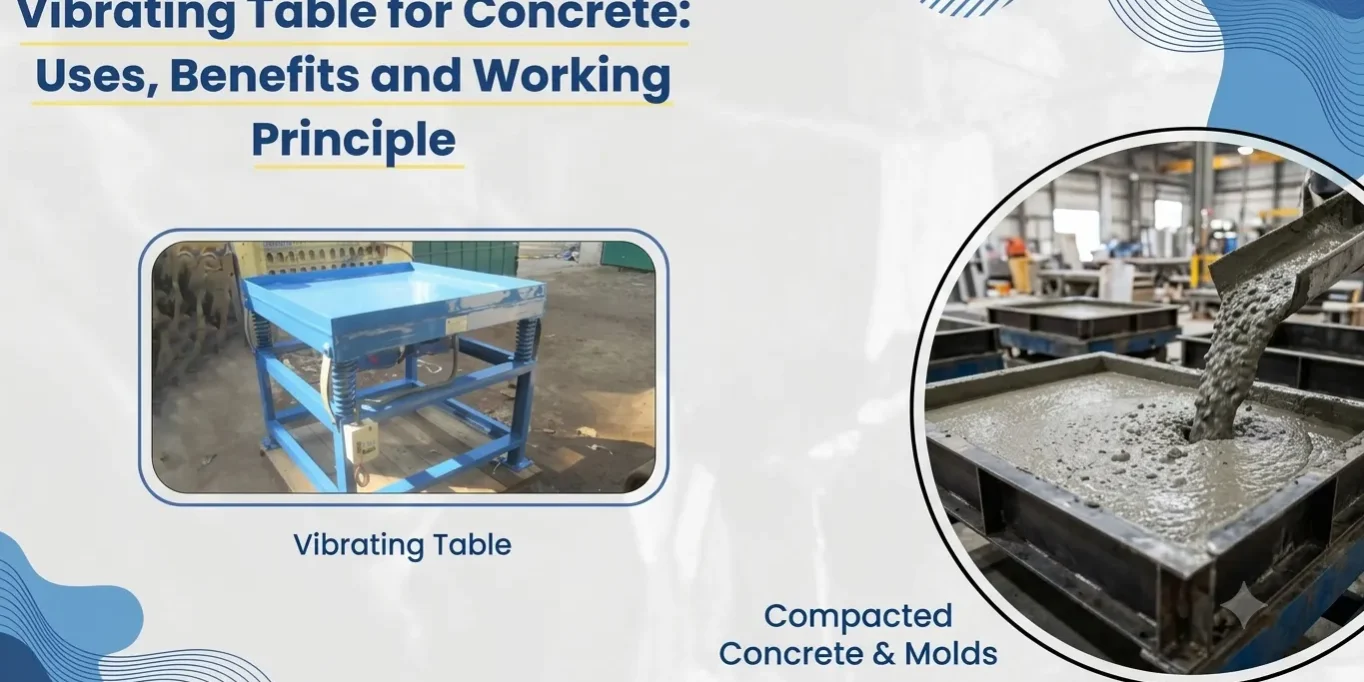
Concrete needs proper compaction after it is placed inside a mould, because fresh concrete contains trapped air, and if that air is not removed, it can affect the density, surface finish, and consistency of the finished product.
A vibration table helps with this issue by providing controlled mechanical vibration to compact concrete inside moulds. These tables are commonly used for precast concrete products and concrete specimen preparation.
In this guide, let’s learn the different uses of vibrating tables, their benefits and working principle.
What is a Vibrating Table?
A vibrating table for concrete is a rigid platform, also known as a compaction table, that has a vibration-generating mechanism, typically a motor with an eccentric or unbalanced weight. When any material, for example, a concrete-filled mould, is placed on the table, the table generates vibrations that pass through the concrete.
These controlled vibrations help the concrete particles rearrange and settle more closely together while allowing entrapped air to escape.
How Does a Vibration Table Work?
The working principle behind vibration tables is simple: controlled mechanical vibration.
First, fresh concrete is placed into the required mould. The filled mould is then positioned on the vibrating table and secured or appropriately restrained so that it remains stable during operation.
When the vibration machinery, such as the motor, starts, its eccentric weight generates a centrifugal force that causes the table to move. The table transfers the vibrations to the mould and its contents.
As the concrete vibrates, the particles rearrange within the mix, entrapped air moves towards the surface and escapes, and concrete settles down to become more consolidated and uniform.
Why Is Concrete Compaction Important?
Fresh concrete naturally contains some air. If significant air voids remain after placement, the finished concrete may have undesirable pores, honeycombing, weak areas, or an uneven surface.
Proper compaction reduces these unwanted voids by helping the concrete settle more closely within the mould. For concrete testing, the vibrating table is part of the specimen preparation process.
Uses of Vibrating Tables in Concrete Applications
There are many concrete-related operations that use vibrating tables, such as:
Precast Concrete Products
Different operations use vibrating tables to compact fresh concrete inside moulds for precast components. A vibrating table uses controlled vibration to mix the fill of the mould and reduce trapped air.
Paver Block and Tile Manufacturing
Paver blocks, tiles, and similar moulded concrete products can benefit from controlled vibration during mould filling and compaction. Proper consolidation can contribute to more consistent density and surface quality.
Concrete Blocks and Small Moulded Products
Vibrating tables can help compact concrete, which is used for manufacturing blocks and other relatively small moulded products, particularly where repeatable production is required.
Concrete Test Specimens
Laboratories and quality-control facilities use vibrating tables to compact concrete specimens in moulds before curing and subsequent testing. Different table sizes can accommodate different numbers and sizes of moulds.
Precast Structural Elements
In suitable manufacturing setups, vibration tables can be used for compacting concrete in moulds for precast structural elements. Table vibration is particularly useful for certain stiff or relatively harsh concrete mixes used in precast production.
Benefits of Using a Vibration Table for Concrete
There are many benefits of using vibration tables and their vibration systems, such as:
Better Concrete Consolidation
The first benefit is that they provide controlled vibrations to help the fresh concrete settle and reduce entrapped air, supporting more effective consolidation.
More Consistent Products
By using vibration tables, you can receive consistent quality products. When the same vibration conditions are applied to successive moulds, it helps achieve greater consistency between production cycles.
Improved Surface Finish
Properly compacted concrete can fill the mould more effectively, which can contribute to a more uniform finished surface.
Reduced Air Voids
Vibration helps trapped air move through the fresh mix and escape, reducing unwanted voids within the concrete.
Efficient Mould Compaction
A vibrating table can compact one or multiple moulds during a controlled cycle, making it useful for repetitive production and laboratory work.
Suitable for Different Applications
The table size, vibration characteristics, motor arrangement, and load capacity can be selected according to the moulds, concrete mix, and production requirements.
Important Performance Factors of Vibration Tables
Many factors affect the efficiency of vibratory tables, such as vibration frequency, amplitude, vibration force, load capacity, table dimensions, and vibration duration.
Vibration frequency describes how rapidly the table will vibrate. The appropriate frequency for your application depends on the concrete mix, mould, and required compaction. Remember, frequency and amplitude (the magnitude of table movement) work together to determine the vibration delivered to the mould.
You need to select the right vibration force for the total mass being vibrated, including the table load, mould, and fresh concrete. Moreover, the table should be capable of safely handling the combined weight of all moulds and concrete placed on it.
Reliable Vibratory Solutions from Electro Flux Equipments
At Electro Flux Equipments, we bring high-quality and robustly constructed equipment. Our wide range of products includes a vibro feeder, vibratory tables, bin vibrators, electromagnets, magnetic screen separators, etc.
Our vibrating tables use robust steel platforms supported by heavy-duty springs or rubber mounts that can be customised in terms of table size, motor capacity, deck material, and mounting options.
Conclusion
A vibration table is an effective solution to compact concrete inside moulds in a controlled and repeatable manner. However, their effectiveness depends on matching the table’s capacity, dimensions, vibration force, frequency, amplitude, and operating time to the concrete mix and mould.
Get in touch with us at Electro Flux Equipments to receive customised options that meet your application-specific requirements. We provide detailed quotations and welcome all queries and questions.