


Are you searching for vibrating feeders and looking for a reliable option that meets all your needs? Then you need to learn more about vibratory machinery, different aspects and factors, to compare and finally choose the correct one for your industry. The right vibratory feeder will do more than simply move materials; it needs to handle your material type, feeding rate, required capacity, and production requirements.
On the other hand, it should not create unnecessary blockages, spillage, maintenance issues, or downtime. Whether you are someone working in mining, cement, food processing, or any bulk-material industry, choosing the right machinery is necessary as it will directly impact the efficiency of your production line. Read this blog to select the right one!
What is a Vibratory Feeder?
We should start by understanding the vibratory machine: in simple terms, it is a material-handling machine that uses controlled vibration to move materials in bulk at a regulated rate. For example, they create a controlled path for your material.
Various industries use these vibratory solutions to control how much material is supplied to the next machine. These feeders regulate the flow at a controlled rate to not allow a large quantity of material to fall at once, which can disrupt the process. For example, take a hopper that contains several tons of raw material; with the correct machine, the vibration will move the material forward, and the feeder will control the flow.
Why Choosing the Right Vibrating Feeder Matters?
Choosing the right feeder is necessary because it directly affects the efficiency, reliability, and performance of your material-handling process. If you end up choosing the wrong feeder, your work progress will get complicated; it may cause inconsistent material flow, blockages, excessive wear, spillage, and unnecessary downtime.
For example, a small feeder cannot work for heavy-duty mining applications. That’s why choosing the right machinery requires considering factors such as the vibrating feeder manufacturers, material characteristics, required capacity, feed rate, installation conditions, maintenance, etc.
Important Factors to Consider
Before looking for the right feeder for your industry, you need to go through these considerations:
- Start with the Material You Need to Feed
Firstly, you need to ask yourself what material you want the feeder to handle. Whether your material is fine and powdery, large and coarse, heavy and abrasive, or moist and sticky can directly affect your choice of the feeder. Hence, before selecting any feeder, you should ensure your material’s particle size, bulk density, moisture, abrasiveness, and flow characteristics.
- Determine Your Required Feeding Capacity
Now you need to consider how much material you want moved per hour. This, we express in tonnes per hour (TPH) or flow rate unit. For example, large-scale mining may require a higher TPH rate, while a small application may require a low feed rate.
- Choose the Right Drive Type & Consider the Required Feed Rate
There are different drive types for vibratory feeders; two important options are electromagnetic drive and mechanical drive. You need to consider both types before choosing your feeder. Electromagnetic feeders are suited for controlled and adjustable material flow, and mechanical vibrating feeders are used for heavier and bulky material. When searching for them, you also need to focus on the material movement equipment’s capacity and feed rate. Whether you need a controlled and consistent rate or a stable and high feed flow, it directly impacts your feeder choice.
- Consider Where the Feeder will be Installed
You must not overlook the place where your feeder will be installed. You need to consider available installation space, hopper or bin dimensions, machine length and width, mounting arrangement, environmental conditions, etc. If you don’t consider these carefully, you will have to redesign your entire production area.
- Consider Maintenance Requirements
Last but not least, you must consider the maintenance requirements of your vibrating feeder and how prone it is to abrasion and wear. Only while considering these will you know whether you need suitable wear liners and surface protectors. Meanwhile, remember that a machine that is easier to maintain can help reduce unexpected downtime and accidents.
Different Industries Need Different Vibrating Feeders
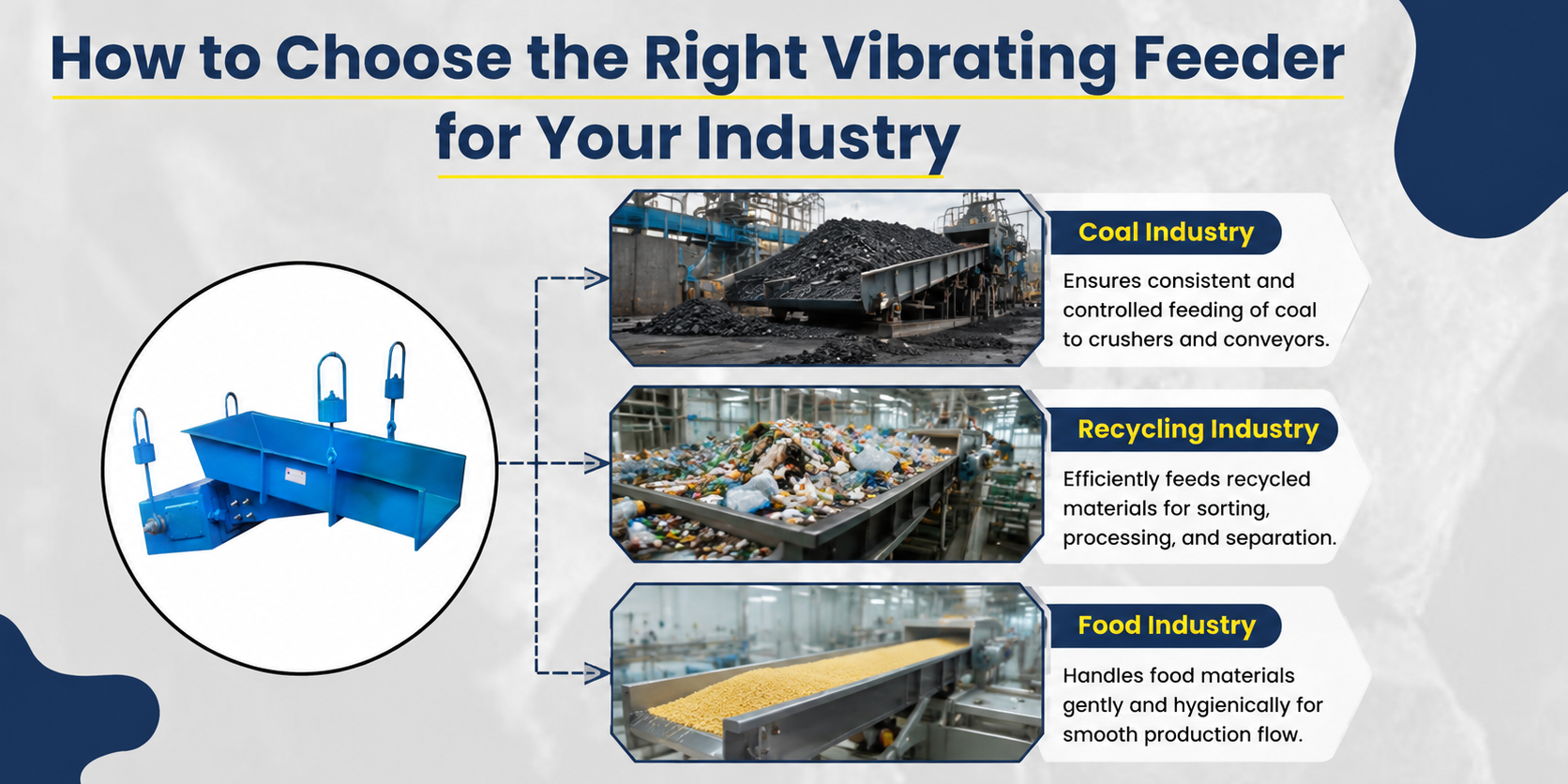
A single vibratory feeder is not suitable for every type of industry. For the Mining and Aggregate industry, you need a robust mechanical feeder; for the Cement industry, a controlled material flow of the feeder is necessary; for Steel Plants and Foundries, considering different conditions is important; for the Food and Pharmaceutical industries, controlled feeding and hygiene are the necessary requirements. Therefore, your industry should directly reflect your choice.
Vibrating Feeder Solutions from Electro Flux Equipments
To find a good feeder, you need to find reliable vibrating feeder manufacturers. At Electro Flux Equipments, we bring years of experience in providing industry-quality, long-lasting solutions. Whether it’s the electromagnetic vibrating feeder or mechanical vibro feeder, our machinery brings consistent and reliable performance for the movement of your bulk material. Furthermore, our solutions, which have gone through many evaluations and vibratory testing, can be selected to suit your application, whether it involves controlled feeding of smaller materials or moving heavier, bulkier materials.
Final Thoughts
If you are considering buying a feeder, carefully go through your workflow and production requirements. What kind of material are you handling, how much of it needs to be moved per hour, how fast and consistent it should be, and what are the installation and maintenance requirements? Carefully think about all these questions.
Meanwhile, compare different vibrating feeder manufacturers to choose a reliable professional like Electro Flux Equipments, a highly experienced manufacturer. Here we offer vibratory feeders for bulk-material handling applications, and customisation options to suit your process requirements. Contact us today to find the right feeder for your industry.