



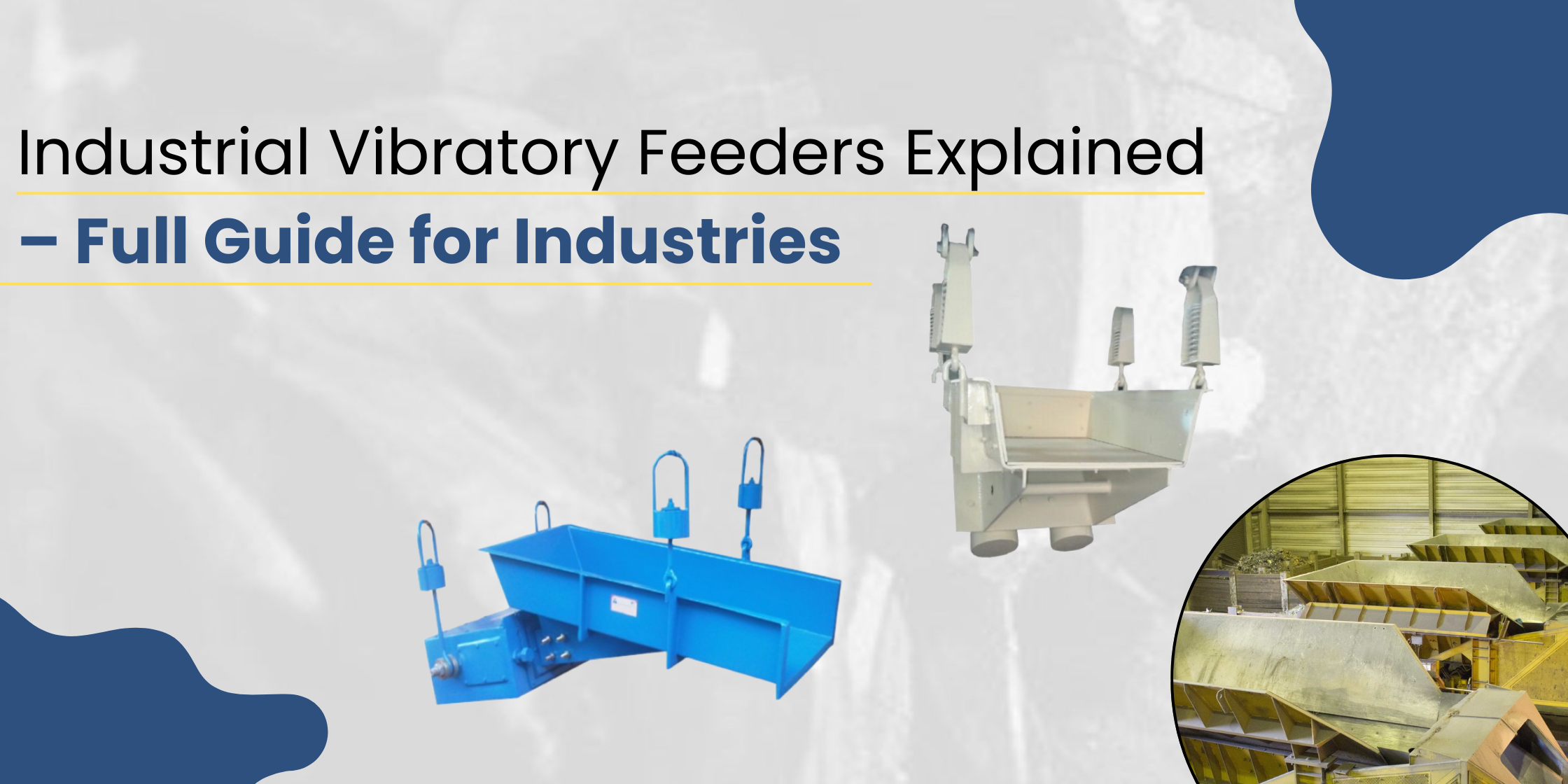
In modern manufacturing and processing today, the efficiency of material movement effectively affects productivity, accuracy, and operational safety. Among the most reliable solutions for controlled and continuous material flow are industrial vibratory feeders. These systems have become an integral part of material handling equipment, offering precision feeding, reducing manual intervention, and increasing production efficiency within food processing, recycling, mining, pharmaceuticals, steel, and chemical manufacturing. As industries continue to head toward automation, the role of a vibratory feeder becomes more significant in ensuring seamless integration with larger systems and helping to maintain throughput consistency.
Controlled vibration is the basic principle whereby a vibratory feeder transports material from one point to another. In doing so, it ensures smooth transportation without degradation or variation in the quality of the material being handled. From powders and granules to aggregates and metal parts, the feeders operate with consistent flow rates and are a must for all industrial sectors that look forward to accuracy, scalability, and reliability.
What are industrial vibratory feeders?
Industrial vibratory feeders are specialty machines designed to move materials in a controlled fashion using oscillating motion. They are an integral part of vibratory feeding systems, which generate vibration either with the help of motors, electromagnetic coils, or mechanical drives. This vibration creates a forward motion that propels material along a tray or trough.
These feeders find broad applications in such varied processes as blending, packaging, sorting, melting, and inspection, since they provide accurate and consistent feeding. They are also important in environments where fragile materials must be moved gently, reducing product damage while maintaining an uninterrupted production line.
A few reasons why many industries choose vibratory feeders are that they are energy-efficient, require very little maintenance, and have long service lives. As part of the general category of industrial vibration equipment, these feeders provide performance to meet the most up-to-date automation needs.
How Do Vibratory Feeding Systems Work?
The main components of a common vibratory feeding system are a feeder tray, a drive unit, a control system, and a supporting frame. The design of the drive unit is normally such that the resulting vibrations, when achieved, produce either linear or circular motion, depending on the design.
There are two major types:
Electromagnetic feeders-characterized with fast response time and accuracy of control, are hence very suitable for lightweight or fine material applications.
The mechanical feeder is appropriate when heavy loads and high throughputs are needed; it is normally used in bulk processing.
In electromagnetic vibrators, the vibration produced in both cases forms the basis for sending materials down the tray at constant rates. This uniformity is a must for quality and safety, as badly fed equipment could be blocked, overloaded, or delayed.
Because these systems are versatile, they also work in harmony with other vibrating equipment, such as screens, conveyors, compactors, and separators. This means companies can develop truly integrated production lines that handle a wide range of materials in the most effective possible ways.
Applications of industrial vibration equipment
Success for any industrial vibration equipment lies in its versatility, as applications in industries handling both bulk and fine materials have supported operations ranging from sorting to feeding, grading, or even compaction.
Usual uses include:
- Beverages and food: Transportation of grains, nuts, spices, and powders in a clean, controlled way.
- Recycling consists of feeding shredded scrap, plastics, or electronic waste into sorting and separation units.
- Mining and minerals: Handling ores, stones, sand, and aggregates.
- Foundry and steel – Feeding metal parts, castings, and slags for further processing.
- Pharmaceuticals and Chemicals: Fine powder handling and processing of sensitive compounds, precision dosing.
Vibratory systems are often the preferred choice of engineers when it comes to designing new production lines or updating obsolete material handling equipment because of their versatility.
Advantages of Using Vibratory Feeders
A great number of advantages account for the now widespread adoption of vibratory feeders.
- Constant flow rate: A vibratory feeder ensures consistent, regulated movement of materials for less downtime.
- Low power consumption: The vibratory system generally requires less power input as compared to other mechanical conveyors.
- Low Maintenance: Fewer moving parts mean less wear and tear.
- Improved Automation: They fit right into automation lines, working in conjunction with other vibratory equipment.
- Reduced Product Damage: ideal for fragile or irregular materials.
These advantages explain why leading manufacturers of vibratory equipment offer companies the possibility to develop tailor-made systems that fit their operational needs.
Choosing the Right Vibratory Equipment Manufacturers
The choice of the right supplier is very important in getting reliable and high-performance equipment. Established manufacturers of vibratory equipment are aware of the industrial challenges and can therefore offer machinery that conforms to material type, production speed, environment, and integration needs.
Among others, considerations include:
- Build quality and strength
- Energy efficiency
- After-sales support and availability of spare parts
- Customization capabilities
- Ability to interface with other vibratory feeding systems
Working with a manufacturer you can trust ultimately implies higher productivity, less downtime, and long-term operational reliability.
Electro Flux Equipments: Your Reliable Partner in Vibrating Solutions
Electro Flux Equipments Pvt Ltd is known for providing long-lasting, efficient, and tailor-made vibrating solutions for industrial applications. As one of the leading vibratory equipment manufacturers in India, the company offers the widest portfolio of vibrating equipment-feeder screens, magnetic separators, and conveyors-engineered for maximum performance.
Their vibratory feeders are precision-designed for heavy-duty production environments, and this makes them an ideal choice for any business seeking material handling equipment. Advanced technology, reliable components, and strong service support at Electro Flux Equipments promise the best performance for all industrial vibration equipment needs.
Conclusion
Industrial vibratory feeders are designed to be intrinsic elements within the making of continuous, effective, and automated material flow in several industries. Their accuracy, robust construction, and integrability with general vibratory feeding systems make them quite indispensable. For companies in search of reliable solutions, Electro Flux Equipments offers ingeniously engineered products aimed at augmenting efficiency in operations and ensuring long-term value.