



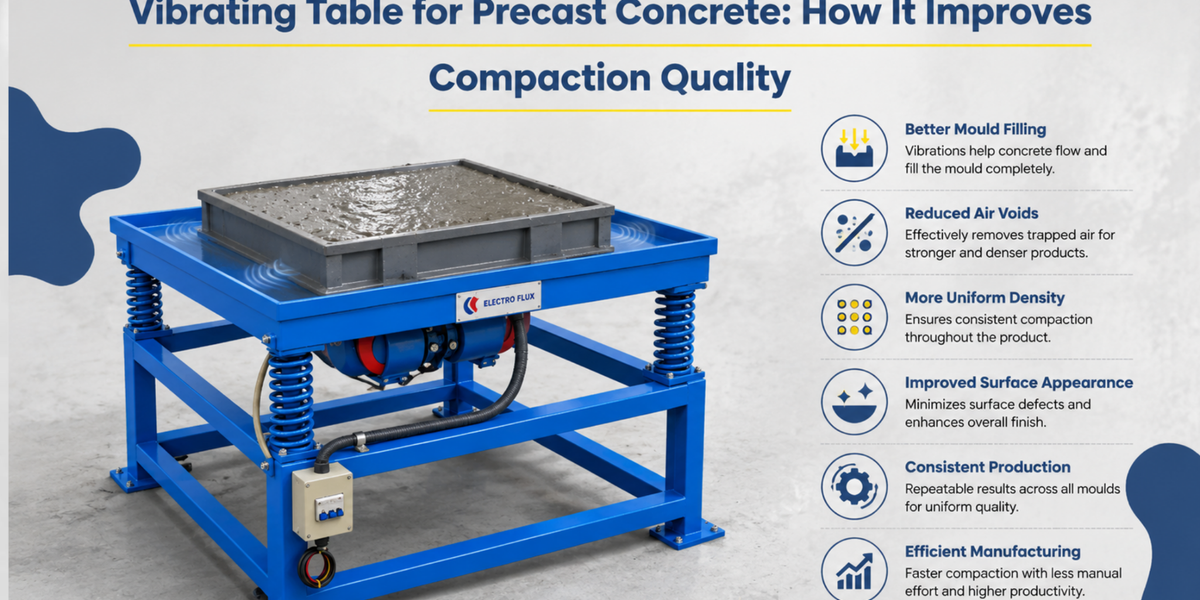
Precast concrete manufacturing is a process of making concrete products in a controlled factory, casting them, curing them, and then transporting them to a construction site for installation. In this process, when concrete is poured into a mould, air can get trapped, creating voids and uneven areas within the finished products. That’s where a vibration table comes into play.
These tables provide a controlled way to compact concrete during the moulding process; they help the concrete settle down evenly, reduce trapped air, and fill the available space more effectively. In this blog, let’s understand what vibrating tables are and how they improve compaction quality for precast concrete manufacturing.
What is a Vibration Table?
A vibration table is a material compaction machine that has a rigid table surface and a vibration mechanism, mostly powered by an unbalanced motor. Once the motor operates, it generates controlled vibration across the table; when the precast concrete-filled mould is placed on this table, the vibration causes the concrete particles to rearrange and settle closer together to help reduce trapped air and improve the overall compaction. In simple terms, a vibrating table is designed mainly for settling, compacting, and consolidating material.
Importance of Proper Compaction in Precast Concrete
Proper compaction is necessary for consistent precast concrete products. When concrete is freshly poured in the mould, air gets trapped, creating air pockets where the concrete does not properly occupy the mould, especially in corners and edges.
If these spaces are not adequately filled, they can cause:
- Air voids in the final product
- Uneven density
- Surface imperfections
- Poor mould filling
- Poor product quality
- Weak areas within the product
To reduce these issues, proper compaction is necessary in precast concrete, and a vibrating compaction table is the right solution.
Key Benefits of Using a Vibrating Table for Precast Concrete
There are several benefits of using an industrial vibration table during precast concrete manufacturing, such as:
- Better Mould Filling – Vibrations help fresh concrete flow and settle down in the mould, which is particularly useful for products with detailed shapes and complex mould designs.
- Reduced Air Voids – A primary purpose and a key benefit of these vibratory machines is to remove trapped air from freshly poured concrete. Reducing air voids contributes to better compaction and a consistent finished product.
- More Uniform Density – In precast concrete manufacturing, it is necessary to have uniform density throughout the mould. The vibrations from these tables help with consistent compaction, which helps produce multiple precast components with similar specifications.
- Improved Surface Appearance – Poorly compacted concrete with air voids can leave visible surface imperfections. Controlled vibrations help the concrete make better contact with the mould to support a consistent finish and improved surface appearance.
- Consistent Production – This repeatable method of applying vibration to settle down concrete helps manufacturers maintain consistent compaction flow across multiple moulds, improving production.
- Efficient Manufacturing – Using these machines reduces the need for manual methods to consolidate the concrete. This makes the compaction process more systematic, and manufacturing more efficient.
Factors to Consider When Choosing a Vibratory Table
Not every vibrating compact table offers the same effect. Manufacturers should select these machines according to their requirements, the characteristics of their product, and the production process.
While choosing vibrating tables, you should consider:
- Mould Size and Weight – The table you buy must support the mould size and the concrete load, so choose the table dimensions wisely.
- Concrete Mix – Different mixtures respond differently to the vibrations. So, understand your concrete before choosing this machine.
- Required Compaction – Your required level of compaction should be considered when determining the right vibration frequency.
- Vibration Frequency and Force – The vibration frequency and force you need should be appropriate for the application and material.
- Production Volume – For a high production volume, you may require equipment with consistent and repeated operation.
- Installation Specifications – Consider your existing space, maintenance requirements, and other installation specifications before choosing the right table.
- Operating Environment – The atmosphere in which you will operate should be considered before selecting the equipment, as different environmental conditions affect it differently.
Applications of Vibrating Tables in Precast Concrete Manufacturing
Let’s explore the common applications of a concrete vibrating table to learn how useful they are for various mould concrete products.
- Paver blocks
- Concrete tiles
- Precast slabs
- Concrete panels
- Small precast components
- Decorative concrete products
- Other moulded concrete products
The Specific table design and vibration requirements should be selected depending on the size, shape, weight, and production method of the manufacturer.
Customization Solutions at Electro Flux Equipments
To facilitate efficient compaction of material, you need a robust vibratory table with adjustable features or customization solutions. At Electro Flux Equipments, one of the top vibrating table manufacturers in India, we offer equipment with a load-bearing capacity of up to 800 kg and a low-maintenance design for long operating life.
Our vibratory machines are applicable for a wide range of industries; furthermore, we realize that one solution does not fit all; hence, we offer customization solutions. Precast concrete manufacturers can choose their preferred table dimensions, motor capacities, deck materials, and mounting options; we also help with quick delivery, on-site training, and responsive post-sales services.
Choose the Right Vibratory Table to Improve Precast Concrete Compaction
A vibration table is an important part of the precast concrete manufacturing process; it helps fresh concrete settle inside the mould, reduce air pockets, and improve consistent compaction. These vibratory mechanisms improve compaction quality and the process by contributing to better mould filling, improved surface appearance, and greater consistency across multiple products.
However, for such positive results, it is necessary to consider these equipment features, your material characteristics, and select a professional industrial equipment provider such as Electro Flux Equipments. By considering these factors carefully while selecting the right vibrating table, manufacturers can create a more controlled and repeatable compaction process for precast concrete products.