


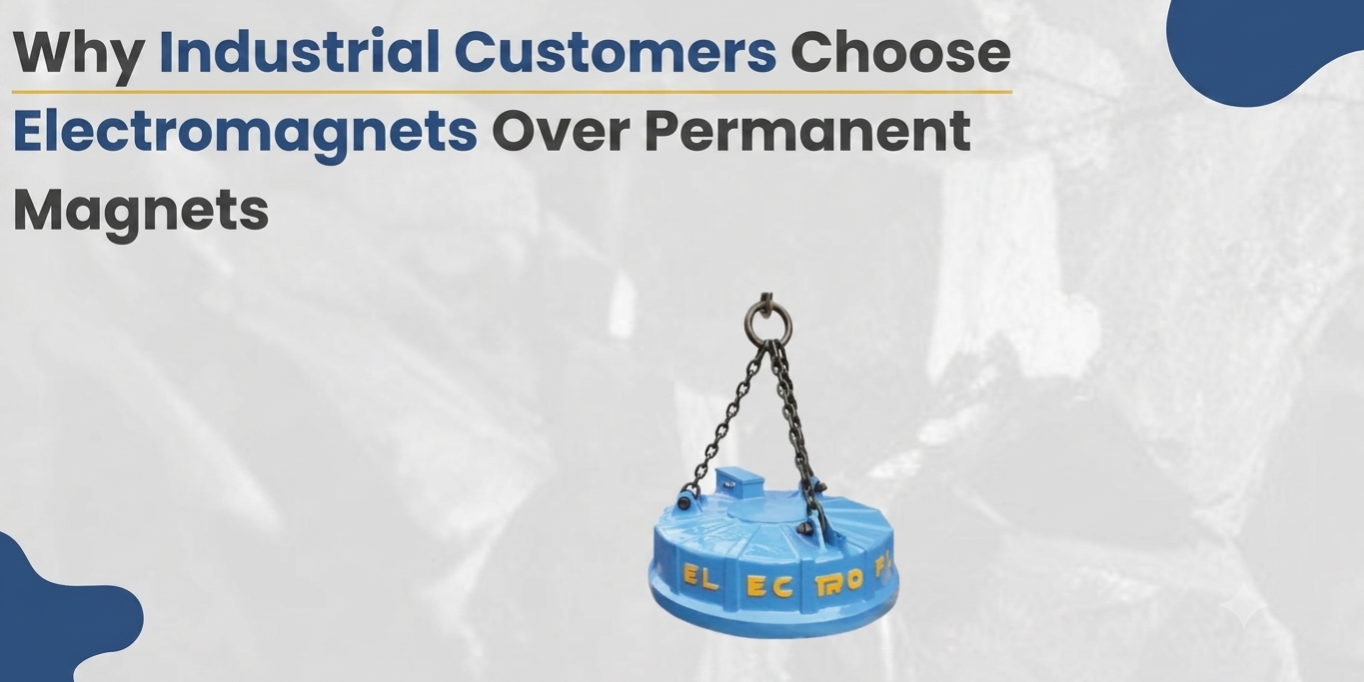
Magnet selection in an industrial setting is rarely a straightforward technological decision. It affects manufacturing efficiency, speed of material handling, safety performance, maintenance requirements, and long-term running expenses. Permanent magnets still find their place in many applications, but when flexibility and operational control are vital, industrial users are increasingly turning to electromagnets.
From electromagnetic separators in mining and recycling facilities to sophisticated lifting systems and computerised production lines, electromagnets have capabilities that permanent magnets cannot simply imitate. Their ability to generate, manipulate and apply magnetic force on demand makes them very effective for modern-day manufacturing operations.
In this article, we will cover seven practical electromagnet advantages, explaining why many industrial users prefer electromagnets over permanent magnets and how this choice can affect productivity, safety and process efficiency.
1. Complete Control Over Magnetic Force
The biggest difference in the debate around electromagnets vs permanent magnets is controllability.
Permanent magnets are always producing a magnetic field. An electromagnet, on the other hand, produces magnetic force only when electrical current is provided. The magnetic field can be turned on or off instantaneously by the operator, and the strength can be adjusted to the task.
This adaptability enhances operating efficiency and decreases the need for manual intervention in manufacturing operations that deal with varying sizes and weights of material.
2. Faster and Safer Material Handling
Speed matters in high-volume production environments.
Industrial lifting systems powered by electromagnets allow operators to engage and release loads with the push of a button. There is no need for chains, slings, or extensive rigging procedures. This reduces handling time while improving workplace safety.
For example, A steel fabrication shop moving hundreds of plates a day can greatly shorten the time it takes to load and unload by using magnetic lifting equipment instead of traditional lifting attachments.
3. Better Performance in Electromagnetic Separators
One major reason industries adopt electromagnetic separators is their ability to provide deeper and more controllable magnetic fields.
In conveyor-based separation systems, electromagnets can pull ferrous impurities from deeper inside bulk material streams. The magnetic field can also be shut off so that gathered metal can be discharged fast and efficiently.
This makes them particularly valuable in:
-
Mining operations
-
Recycling facilities
-
Cement plants
-
Power generation facilities
-
Aggregate processing plants
The result is improved product purity and reduced equipment damage caused by unwanted metal contamination.
4. Greater Adaptability for Different Applications
Industrial processes rarely stay static.
An electromagnet can be integrated into lifting systems, automated production equipment, robotic handling applications, sorting lines, and separation systems. Because magnetic strength can be adjusted, the same system can often accommodate varying load types and operating conditions.
This adaptability gives industrial buyers more long-term value compared with fixed-strength magnetic systems.
5. Improved Precision and Automation Compatibility
As factories move towards automation, precision becomes increasingly important.
Industrial electromagnets enable very precise control for engaging and disengaging magnetic force. This permits accurate placement of parts in assembly, packaging, machining and robotic handling activities.
Unlike permanent magnets, which are separated using mechanical means, electromagnets interact seamlessly with automated control systems and programmed manufacturing settings. For manufacturers investing in Industry 4.0 initiatives, this advantage is particularly significant.
6. Advanced Solutions Through Electro Permanent Lifting Magnets
Nowadays, more and more modern facilities are using electro permanent lifting magnets because they combine the strengths of both technologies.
These systems consume electrical energy solely during magnetisation and demagnetisation cycles. Once the magnetic force is activated, it continues even if power is cut. This creates a good balance between safety, energy efficiency and operational management.
Key benefits include:
-
Reduced power consumption
-
Secure load holding during power loss
-
Remote operation capability
-
Minimal maintenance requirements
-
Reliable lifting performance
For heavy steel handling applications, electro permanent lifting magnets often provide an effective alternative to traditional lifting methods.
7. Stronger Magnetic Reach for Challenging Loads
Some applications demand greater magnetic penetration.
Many permanent magnetic devices cannot generate magnetic fields as powerful and as deep as electromagnets. This gives them greater capability to deal with bigger sections of steel, stacked material and loads with small air gaps.
This capability becomes particularly important in:
-
Steel service centres
-
Shipbuilding facilities
-
Scrap processing operations
-
Heavy engineering workshops
In these environments, the additional magnetic reach can directly improve productivity and material flow.
Understanding the Role of Suspension Permanent Magnet Systems
Although electromagnets offer many operational advantages, a suspension permanent magnet still plays an important role in industrial separation applications.
These systems are generally used where there is no electricity, or where a constant magnetic attraction is needed without electricity. A suspension permanent magnet is a cost-effective, low-maintenance method for removing light-workload ferrous contaminants.
The final decision is based on operational conditions, material properties and manufacturing goals.
Electro Flux Equipments: A Trusted Name in Industrial Magnetic Solutions
When it comes to choosing magnetic handling and separation technologies, supplier competence is as crucial as product selection. Electro Flux Equipments, with expertise in magnetic lifting systems, separation equipment and custom material handling solutions, has built a strong reputation in the industrial magnet market.
We are active in many sectors, such as steel processing, mining, recycling, energy generation and manufacturing. Our focus on application-specific engineering allows our customers to decide on the best magnetic technology for their unique needs, rather than adopting a one-size-fits-all strategy.
Conclusion
The selection of permanent magnets against electromagnets depends on the application, although many of today’s industrial activities reap the obvious benefits of electromagnets. Greater control, improved safety, stronger magnetic reach, automation compatibility, and the versatility of electromagnetic separators and electro permanent lifting magnets make them particularly valuable in difficult applications.
A suspension permanent magnet may work for some applications, but for enterprises that need efficiency, flexibility and process control, electromagnet technology is the more feasible long-term investment. Companies like Electro Flux Equipments continue to fuel this trend by offering solutions that correspond with the changing needs of industries.