



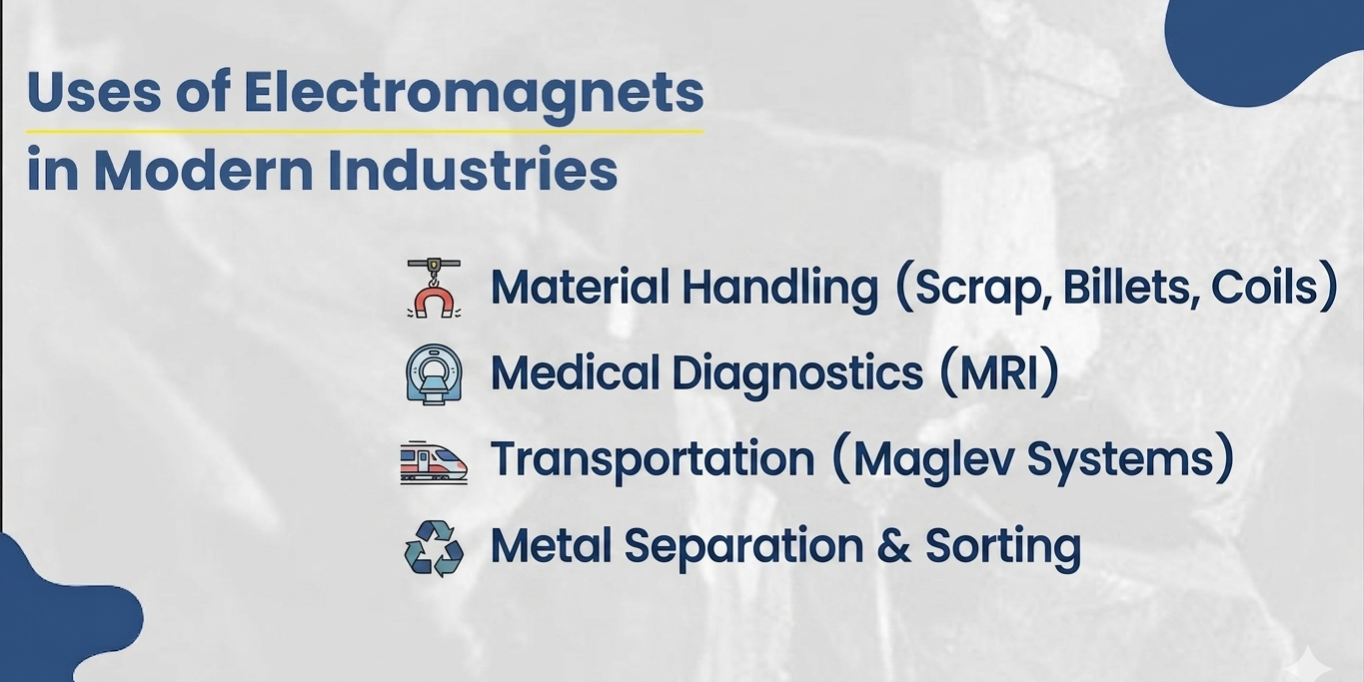
Electromagnets are used in many industrial systems, yet most people never get to see them working. From lifting large steel plates in fabrication yards to enabling automated manufacturing lines, they help industries to increase productivity, safety and precision.
Electromagnets do not work like regular magnets. They only produce a magnetic force while electricity is flowing through them. That means operators may turn them on and off, modify their strength and incorporate them into automated machinery. This adaptability is why electromagnets are increasingly being used in manufacturing, transport, healthcare and engineering sectors.
This guide will explore the top 10 real world applications of electromagnets to help industrial buyers know the uses of electromagnets and wisely select the equipment that supports their level of productivity and operations.
What Are Electromagnets Used For?
An electromagnet is made up of a coil that has been wound around an iron core. Once electricity flows through the wire coils, it generates a magnetic field.
Electromagnets can control the magnetic field; therefore, they are commonly utilised in industrial systems where precision, mobility and safety are important. Their ability to handle large materials, automate processes, and enable high-speed operations makes them highly indispensable in today’s business.
1. Scrap Handling and Steel Lifting
A most common electromagnet example is found in steel plants and scrap yards.
Large lifting magnets attached to cranes are used to move steel scrap, billets, plates, and pipes quickly and safely. These systems reduce manual handling and improve loading efficiency in demanding industrial environments.
For industries dealing with heavy ferrous materials every day, electromagnetic lifting equipment helps save time while improving workplace safety.
2. Magnetic Separation Systems
Magnetic separators are widely used to remove metal contamination from production lines.
Industries using these systems include:
- Mining
- Recycling
- Food processing
- Cement manufacturing
- Pharmaceuticals
Electromagnetic separators help protect machinery from damage and improve product quality by removing unwanted ferrous particles from raw materials.
3. Industrial Automation and Robotics
Automation is one of the fastest-developing areas when discussing the modern uses of electromagnet technology in industrial operations.
Electromagnetic grippers are frequently employed in robotic arms, conveyor systems and automated assembly lines. Magnetic force can be regulated quickly, thus components can be picked up and released with high precision.
This is particularly important in the automotive and heavy engineering industries, where speed and repeatability are of vital importance.
4. Electric Motors and Industrial Machinery
Many industrial equipment are based on electromagnetic principles.
Electric motors employ magnetic fields to transform electrical energy into mechanical motion. The technology behind this is the basis for pumps, compressors, conveyor systems and CNC machines.
Modern manufacturing and industrial processing would be substantially different without electromagnets.
5. Electromagnetic Braking Systems
Electromagnetic brakes are widely used in equipment that requires controlled stopping power.
These systems are commonly found in:
-
Elevators
-
Hoists
-
Trains
-
Packaging equipment
-
Wind turbines
Compared with conventional braking systems, electromagnetic brakes respond quickly and reduce mechanical wear. That makes them particularly valuable in high-cycle industrial operations.
6. MRI Machines and Medical Equipment
Electromagnet uses are not limited to factories and engineering plants.
MRI scanners use powerful electromagnets to provide detailed images of the inside of the human body. The controlled magnetic field enables precise diagnostic imaging utilised in hospitals across the globe.
This application demonstrates how electromagnets support both heavy industrial operations and highly precise medical technologies.
7. Relays and Solenoids
Industrial control systems use electromagnets in relays and solenoids every day.
These components are essential in:
-
PLC systems
-
Hydraulic equipment
-
Pneumatic machinery
-
Automated valves
-
Industrial locking systems
A solenoid converts electrical energy into mechanical movement, allowing machines to perform automated tasks with speed and accuracy.
8. Maglev Transportation Systems
One advanced electromagnet example is magnetic levitation transport.
Maglev trains use electromagnets to levitate and propel train carriages, with very little friction. Due to the relatively limited contact with the rails, these systems can be operated at very high speeds, minimising wear and maintenance.
Although still limited to selected regions, maglev technology highlights the future potential of electromagnetic engineering.
9. Industrial Audio and Communication Systems
Electromagnets are also used in speakers and industrial communication systems.
Electromagnetic coils in alarms, factory announcements, and public-address systems turn electrical signals into sound waves.
Large industrial sites need dependable communication systems for the coordination of operations and the safety of work.
10. Scientific Research Equipment
Electromagnets are employed in research laboratories in equipment where magnetic fields must be very carefully controlled.
Applications are:
-
Particle accelerators
-
Testing Semiconductors
-
Material evaluation
-
Systems for calibration
-
Scientific research equipment
Electromagnetic strength can be fine-tuned so researchers can do more sophisticated testing and experimentation.
Why Electromagnets Matter in Industry
The primary advantage of electromagnets is that they can be controlled.
Unlike permanent magnets, they can be turned on and off instantly, incorporated into automated systems and changed to fit operating needs. This allows enterprises to improve handling efficiency, minimise physical labour and support safer manufacturing environments.
As manufacturing becomes more automated, the answer to how are electromagnets useful becomes even clearer. They support faster operations, greater precision, and better process control across a wide range of industries.
How Electro Flux Equipments Supports Modern Industrial Magnetic Applications
Electro Flux Equipments has established itself as a reliable name in the field of industrial magnetic equipment and electromagnetic solutions. The company has experience in industries such as steel, recycling, power generation, cement and heavy engineering and makes solutions for efficient material handling, hoisting and magnetic separation.
The product range is used in industries where reliable performance in harsh operating environments is required. Electro Flux Equipments is a go-to for businesses desiring strong and efficient electromagnetic technology by focusing on practical engineering, operational reliability and industry-specific requirements.
Conclusion
The expanding range of electromagnet uses illustrates the significance magnetic technology has assumed in contemporary business. Electromagnets boost productivity, safety and operational control for organisations, from lifting and automation in steelworks to medical imaging and transit systems.
Industrial buyers who understand how are electromagnets useful and partner with reliable manufacturers like Electro Flux Equipments make better selections when investing in equipment that will support long-term productivity and performance.