


Industrial magnets are a vital part of modern manufacturing, enabling more efficient material handling, metal separation, and equipment protection across a wide range of sectors. Whether you’re in a steel mill or foundry, recycling centre or mining, the appropriate industrial magnet makes a difference, directly impacting productivity, safety and operational costs.
Understanding the numerous industrial magnet types is the first step to selecting the right equipment for your application. Whether it’s an industrial electromagnet for heavy lifting or a permanent magnetic system for continuous metal separation, each solution is customised to meet specific operating needs.
This guide discusses the most popular types of industrial magnets, their uses and the critical considerations before making an investment.
Understanding Industrial Magnet Types
Industrial magnets are of two principal types: electromagnets and permanent magnets. Both provide magnetic force, but act differently and are suitable for distinct industrial uses.
The selection relies on load characteristics, duty cycle, availability of power, temperature and maintenance expectations. Experienced engineers will generally begin with an analysis of the process, rather than picking a magnet based on lifting capacity alone.
Industrial Electromagnet: Controlled Magnetic Performance
An industrial electromagnet generates its magnetic field by running an electric current through a coil of copper or aluminium wire wound around a steel core. When the power supply is switched off, the magnetic field disappears, and the material can be immediately released by the operators.
They are ideal for applications requiring constant raising and dropping due to the controlled action of electromagnets.
Common applications include:
- Steel mills handling slabs and billets
- Scrap yards lifting mixed ferrous scrap
- Foundries transporting castings
- Shipbreaking operations
- Heavy fabrication workshops
One technical advantage is the capacity to produce high magnetic fields for difficult lifting jobs. Many industrial lifting electromagnets are powered by DC supply voltages ranging from 220 V to 230 V. The magnetic field strength near the contact surface sometimes reaches 1 Tesla under rated operating circumstances, depending on the design and application.
Permanent Magnets: Reliable Operation Without Power
Unlike electromagnets, permanent magnets provide a steady magnetic field without the need for power. Modern designs employ rare-earth elements or ferrite magnets and are reliable for continuous separation and protection applications.
Permanent magnets are extensively employed where continuous operation is vital and electrical power is absent or not required.
Typical applications include:
- Conveyor belt protection
- Food processing
- Mining operations
- Recycling facilities
- Aggregate handling
Their simple construction reduces operating costs because they consume no electrical power during normal use. They also require relatively little maintenance compared with electrically energised systems.
Comparing Electromagnets and Permanent Magnets
Although both technologies serve valuable roles, they solve different operational challenges.
Choose electromagnets when:
- Materials require controlled lifting and release
- Loads vary in size and weight
- High lifting force is essential
- Operators need precise handling
Choose permanent magnets when:
- Continuous magnetic separation is required
- Energy efficiency is a priority
- Maintenance access is limited
- Equipment operates continuously
Understanding these differences helps procurement teams avoid overspecifying equipment or investing in systems that do not suit the production process.
Common Industrial Magnet Types Used Across Manufacturing
Beyond the basic distinction between electromagnets and permanent magnets, several specialised designs serve different industries.
1. Lifting Electromagnets
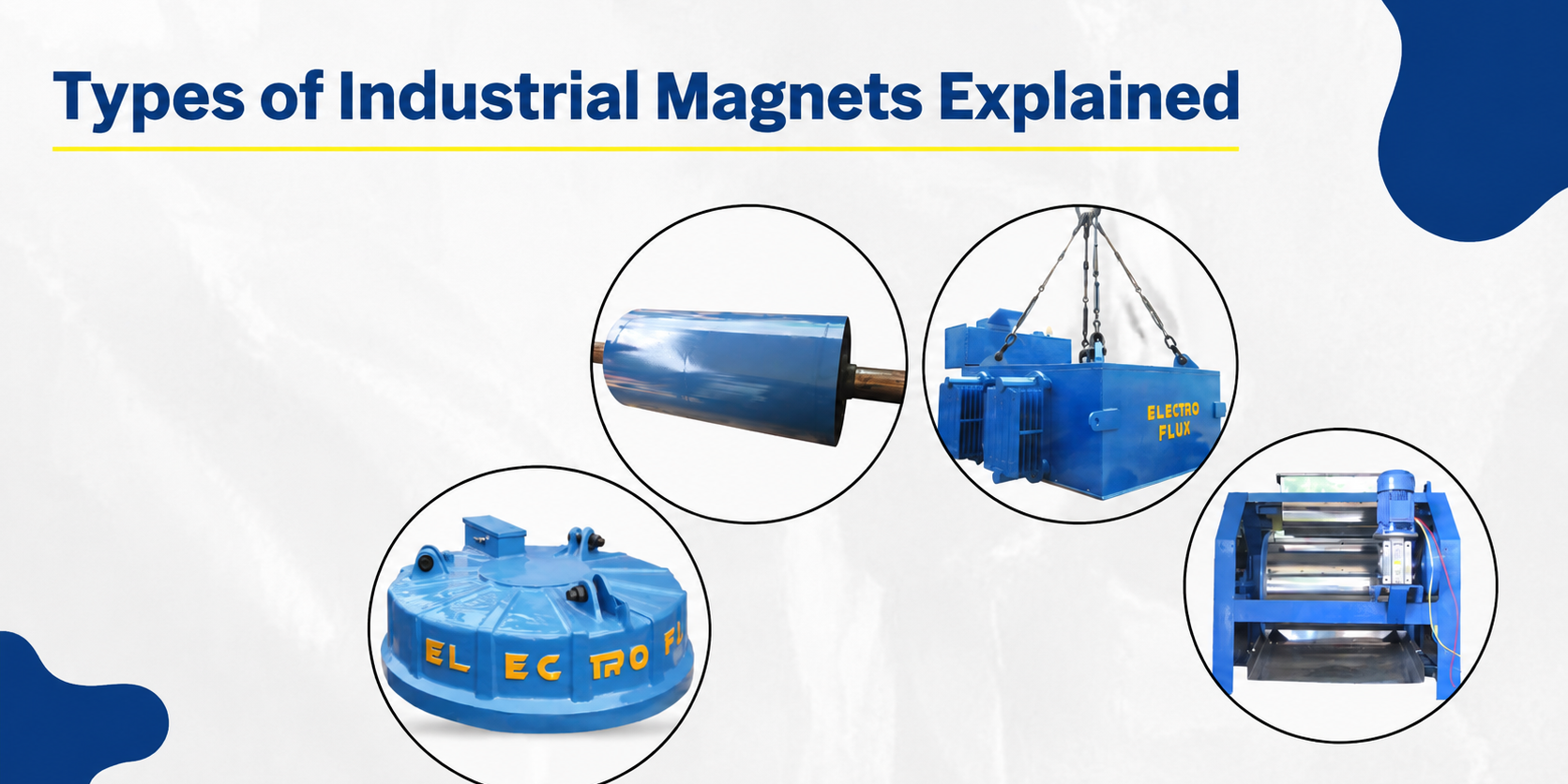
Lifting Electromagnets are used for handling heavy ferrous items such as steel plates, billets, blooms, pipes, coils and structural sections. Their magnetic field is only generated when power is given, permitting operators to lift and release loads safely and accurately. They are common in steel mills, foundries, warehouses, ports and fabrication shops where routine material handling is a daily aspect of the activity.
3. Magnetic Head Pulleys
Magnetic head pulleys are used in place of conventional conveyor pulleys at the discharge end of a belt. The ferrous particles are attracted to and removed from the main product stream as it passes over the pulley, without halting production. They are commonly utilised in recycling plants, mining operations, wood processing and bulk material handling industries where continuous automatic separation improves process efficiency.
4. Magnetic Drums
Magnetic drum separators continuously remove iron impurities from free-flowing bulk materials. Ferrous particles are attracted to and held by rotating drums; non-magnetic materials flow through. Their automatic operation makes them suited for high-capacity applications in recycling, mineral processing, coal handling, ceramics and food processing industries where constant separation is required.
5. Suspension Magnets
Suspension magnets are mounted on top of conveyor belts to remove ferrous metal prior to reaching downstream processing equipment. They are available in electromagnetic and permanent magnetic configurations and protect crushers, shredders, screens and mills from tramp iron damage. They are widely used in mining, cement, recycling and bulk material handling sectors due to their easy installation and stable operation.
Choosing the Right Industrial Equipment Supplier
Choosing magnetic equipment is not just a case of looking at product catalogues. A reliable industrial equipment supplier is familiar with material behaviour, production goals, installation limitations and long-term maintenance requirements.
Before selecting a supplier, buyers should evaluate:
- Industry-specific application experience
- Engineering and customisation capability
- Manufacturing quality standards
- Testing procedures
- Availability of technical support
- Spare parts and after-sales service
Many production issues originate from incorrect equipment selection rather than manufacturing defects. Working with knowledgeable Electromagnet Suppliers helps minimise this risk by matching equipment to actual operating conditions.
Electro Flux Equipments: Engineering Magnetic Solutions for Diverse Industries
Choosing magnetic equipment is rarely a one-size-fits-all decision. Application expertise is very important because different sectors deal with varied materials, manufacturing quantities and operating environments. Electro Flux Equipments has made its name in developing magnetic solutions, overcoming these practical issues in steel manufacture, mining, recycling, power generation, cement, ports and heavy engineering.
The company produces a wide range of lifting and separating equipment and also supports industrial buyers with application assessment, system integration and solution customisation. This engineering-driven strategy helps companies enhance material handling efficiency, protect precious processing equipment and provide reliable performance in demanding industrial operations.
Conclusion
Selecting the correct industrial magnet requires understanding how each technology operates in real-world operating environments. Industrial electromagnets give controlled lifting for demanding handling applications, whilst permanent magnets give reliable separation with minimal running costs. When linked to the process correctly, both are important in modern manufacturing. Partnering with an experienced industrial equipment supplier like Electro Flux Equipments is more likely to result in equipment that performs consistently for many years.