


Magnetism is an integral part of contemporary engineering, electronic technology, and industry processes. Whether it’s an electric motor or generator, or even a conveyor separation system, the interaction of the material with the magnetic field will influence the performance of the equipment.
Minor alterations in magnetic properties can result in changes in its operation mode when working with the load. In order to comprehend the practical usage of magnetism, one must know the nature of magnetic materials and their reaction to magnetic force.
This guide provides detailed information about the three groups of magnetic materials, their properties, and practical usage in industry.
What Is Magnetic Material?
Before classification, you must know what is magnetic material. A magnetic material is any type of substance that reacts to a magnetic field, either strongly, weakly, or sometimes even oppositely, based upon its internal composition.
The origin of magnetism lies at the atomic level in the movement of electrons. Electrons spin in such a way that magnetic properties develop within the material.
What Are the Types of Magnetic Materials
In the fields of physics and engineering, researchers classify all substances into three general classes depending on their behaviour within a magnetic field. The following are the three classes of magnetic substances that you will encounter most frequently:
- Diamagnetic materials
- Paramagnetic materials
- Ferromagnetic materials
These different types of magnetic materials have unique properties, which make them suitable for different applications.
1. Diamagnetic Materials
Materials that are diamagnetic respond weakly to any magnetic fields. These materials actually produce a weak repulsive force when brought close to a magnetic field.
Key Features:
- Reacts weakly to magnetic fields
- Cannot maintain their magnetic property without a source of external magnetic fields
- Magnetic susceptibility of the material is negative
- Found in all materials, although they can be dominated by other forces
How it Works
When diamagnetic materials are exposed to an external magnetic field, the behaviour of their electrons changes in a slight way. Consequently, a weak opposite magnetic field is formed.
Examples
Some of the simplest magnetic materials examples that are diamagnetic include:
- Bismuth
- Copper
- Gold
- Water
2. Paramagnetic Materials
Paramagnetic materials have a weak attraction to magnetic fields. They do not oppose magnetic fields like diamagnetic materials, and therefore have a slight attraction to the field.
Key Characteristics
- Have a weak attraction to magnetic fields
- Do not maintain magnetisation when the magnetic field is withdrawn
- The susceptibility to the magnetic field is positive and low
- Attraction becomes more effective with increased magnetic field strength
Working Principle
Some electrons in the material do not form pairs. When exposed to a magnetic field, these electrons align with the field, creating a weak attraction.
Examples
Examples of magnetic materials in this group are:
- Aluminum
- Platinum
- Magnesium
- Oxygen
They have specialised uses in electronics and sensor technologies.
3. Ferromagnetic Materials
Among all materials, ferromagnetic materials are the most significant group industrially. They possess a high attraction towards magnetic fields and also retain their magnetism when the magnetic field disappears.
Key Features
- Attraction to magnetic fields
- Can become permanent magnets
- Very high magnetic susceptibility
- Long-lasting magnetism
How it Works
In these materials, there are some magnetic domains that align themselves in the same direction whenever they are exposed to a magnetic field.
Popular Examples
Popular magnetic materials examples that are Ferromagnetic in nature include:
- Iron
- Nickel
- Cobalt
- Steel
Understanding the Differences
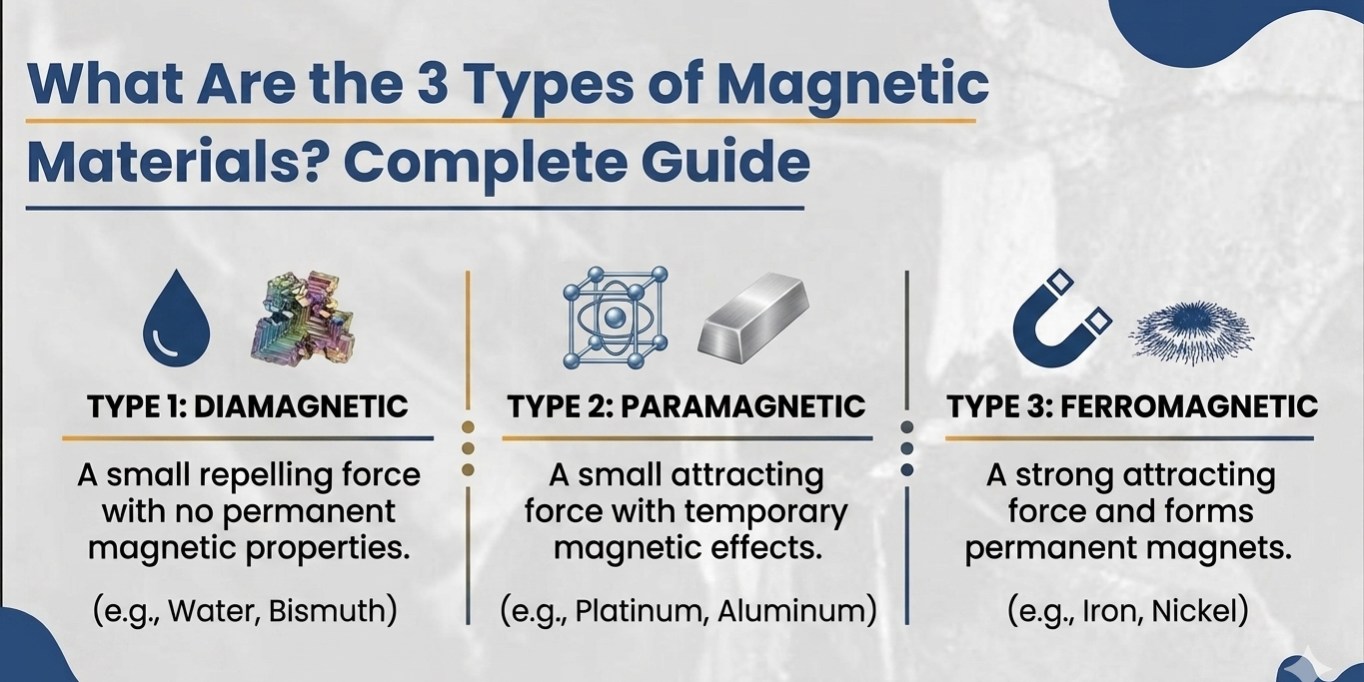
As you observe the various magnetic materials, the distinction can be made based on their ability to respond to magnetic forces and whether they can maintain magnetism.
- Diamagnetic materials exhibit slight repulsion
- Paramagnetic materials have a slight attraction
- Ferromagnetic materials have a strong attraction and can maintain magnetism
This classification helps engineers decide which material to use for a specific application.
What Materials Are Magnetic in Practical Use?
Taking a closer look at the industrial use, one can conclude that not all materials possess the properties required to be magnetic. So, what materials are magnetic in nature?
Ferromagnetic materials make up most of the industrially used materials. For example:
- The iron core in transformers makes their performance more efficient.
- Steel is utilised as a component in machinery.
- Equipment, including magnetic separators, makes use of their ferromagnetic nature to separate metal impurities.
Paramagnetic and diamagnetic materials have niche uses but are less common in heavy-duty applications.
Why Classification Matters in Industry
Understanding of the different kinds of magnetic materials goes beyond theory, and it has practical implications for design and safety considerations. For instance:
- The mining industry uses magnetic separators that use ferromagnetism to separate metal bits.
- Electronic systems use paramagnetic material to manage current flow in particular electronic parts.
- Magnetic resonance imaging (MRI) utilises diamagnetism in its operation process.
The awareness of which materials possess magnetic characteristics enables engineers to pick the appropriate one for their application.
Practical Applications Across Industries
The use of magnetic materials spans multiple sectors:
- Manufacturing
Magnets are useful in separating, picking up, and moving metallic components. It makes work faster and more effortless.
- Mining and Cement
The magnet separator removes any unwanted metallic impurities from the materials. This prevents any damage to machinery.
- Electrical Engineering
The transformer and electric motor rely on ferromagnetic materials in their operations.
- Automotive Industry
Magnets play a major role in manufacturing sensors, alternators, and braking systems.
Electro Flux Equipments: A Trusted Magnetic Equipment Manufacturer
For magnetic solutions across various industries, Electro Flux Equipments has gained immense popularity over the years. We design equipment using the principles of magnetism in order to accomplish tasks related to separation, lifting, and material handling.
Our equipment has been extensively applied in industries such as mining, scraping, and cement plants. They have been reliable and robust enough to perform in heavy-duty applications.
Conclusion
The classification of various magnetic materials as diamagnetic, paramagnetic, and ferromagnetic is the basis on which modern engineering practices have been built. These materials respond to magnetic fields in various ways.
This difference in response influences their practical application in different industries. Companies like Electro Flux Equipments apply these principles to create efficient solutions that support large-scale operations.